
- Family
- Basis of family formation
- Forms of marriage
- Marriage in terms of the number of husbands/wives
- Marriage in terms of the origin of husband and wife:
- Exogamous marriage
- Endogamous marriage
- Homogamous marriage
- Heterogamous marriage
- Other forms:
- Lineage
- Residence
- In-group (close group)
- Family
- Basis of family formation
- Forms of marriage
Marriage in terms of the number of husbands/wives
- Monogamy is a form of marriage where the husband does not marry another woman and the wife does not marry another man. In short, monogamy is a marriage between one man and one woman without any other marital ties.
- Polygamy is a form of marriage in which a man marries multiple women or a woman marries multiple men.
Polygamy can be classified into two types:
- Polygyny: One man has many wives. It is called sororal polygyny if the wives are biological sisters and non-sororal if the wives are not sisters.
- Polyandry: One woman has many husbands. It is called fraternal polyandry if the husbands are brothers and non-fraternal if the husbands are not related as biological brothers.
Viewed from the origin of the husband and wife:
- Exogamous marriage is a marriage between different ethnicities, clans, tribes, or kinships. Exogamy can be divided into two types:
- Asymmetrical connubium exogamy occurs when two or more environments act as givers or receivers of brides, such as in the Batak and Ambon tribal marriages.
- Symmetrical connubium exogamy is when two or more environments exchange partners for their youths.
- Endogamous marriage
Endogamy is a marriage within the same ethnicity, clan, tribe, or kinship environment. - Homogamous marriage
Homogamy is a marriage between the same social class groups, such as the child of a merchant marrying the child of another merchant. - Heterogamous marriage
Heterogamy is a marriage between different social classes, for example, a nobleman’s child marrying a farmer’s child.- Other forms:
- Lineage
- Residence
- Cross Cousin
Cross Cousin is a form of marriage between the children of siblings of different sexes. - Parallel Cousin
Parallel Cousin is a form of marriage between the children of siblings of the same sex.
- Other forms:
Elements of Culture#
Kluckhohn argued there are 7 elements of culture:
- Human life equipment and supplies
- Livelihood and economic systems
- Societal systems
- Language
- Arts
- Knowledge systems
- Religion
Value Culture#
- Regarding the social environment, students need to be introduced to a value culture concerning social conditions that tend to lack respect for value culture, with the spread of violence in society and even in families.
- Displayed 12 living values.
Personal Reflection Material#
- What cultures influence your life the most right now? Name exactly what they are, and why they have a significant impact on you.
- What personal habits do you want to cultivate in your life (which could also influence others, for example, your family), and what personal habits do you want to change or leave behind because they do not help improve your relationships with others?
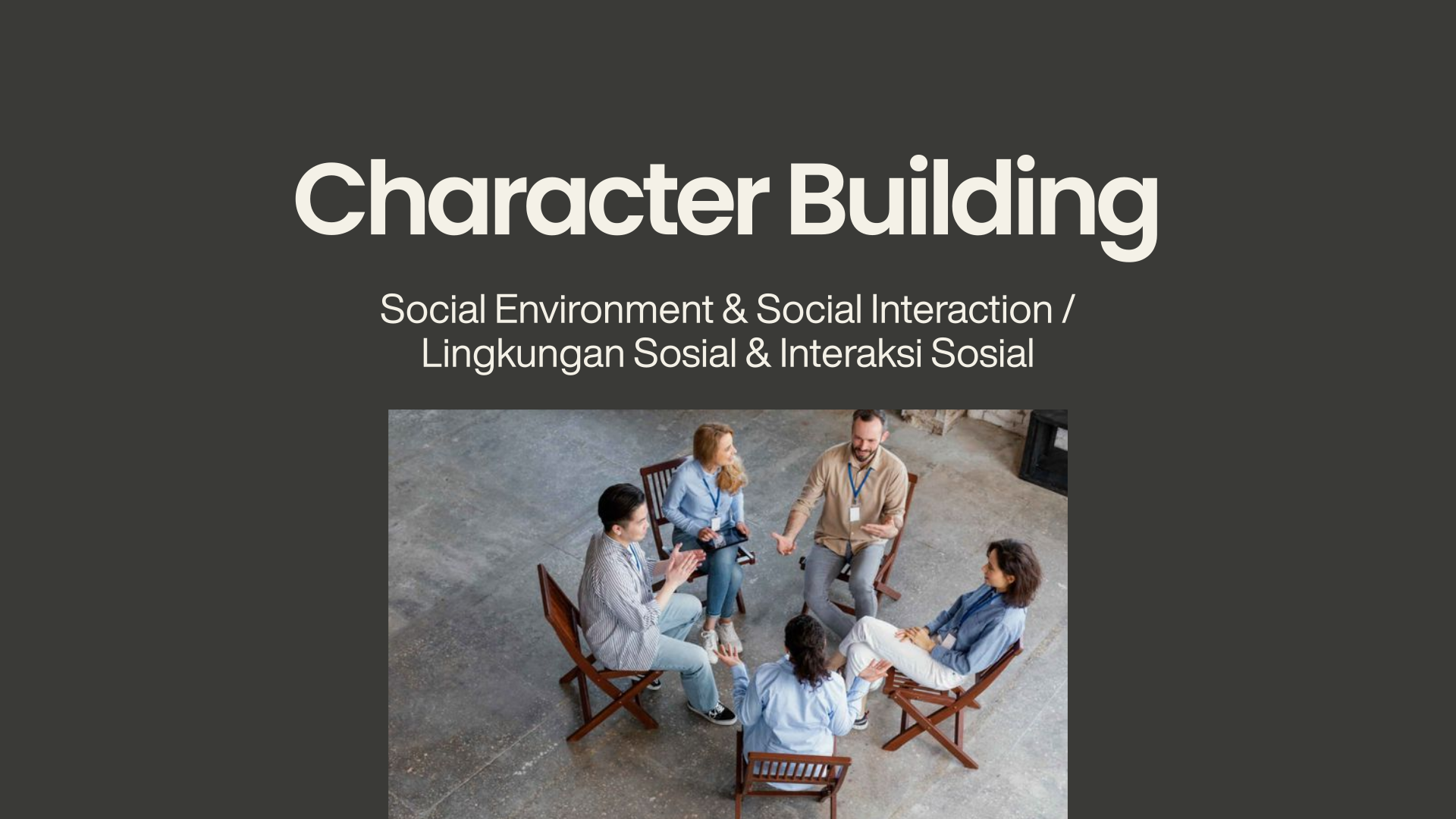
Social Interaction#
Social Communication#
Communication from the Latin word, communicatio, means the act of informing, notification, sharing, exchanging.
Social comes from the Latin word, socius, which means friend or companion.
Social communication can generally be defined as a form of interaction between individuals or groups carried out verbally or non-verbally with the intention of conveying a message, in a way that can be understood by both parties and is capable of producing a response that can be understood by both parties.
A. Definition of Value#
Explicitly, value can be understood as a conception internalized by an individual/group regarding what is important or less important, what is better or worse, what is more right or less right.
B. Definition of Norm#
- Norm in general: a measuring tool made from various basic materials with different sizes and shapes.
- Norm as a rule of assessment consideration.
Types of Behavioral Norms:#
- Specific norms
- General norms:
- Norms of politeness
- Legal norms
- Moral norms
Connection between Values and Norms#
- Norm as a manifestation of value
- Norm as a protector of value
- Norm that has the potential to hide or blur the value
Social conflict: opposition, bickering, disputes, or disagreement between groups in society.
Conflicts can occur between community groups or conflicts that arise in interpersonal relationships.
Conflicts between community groups occur due to:
- Conflicts between religious groups
- Inter-ethnic conflicts
How to manage conflict: Johnson in Supratiknya, (1999) and Hardjana, (2001)
- Shark Style: likes to conquer opponents by forcing them to accept the conflict solution they propose.
- Owl Style: conflict is a problem that must be solved in a way that aligns with personal goals as well as the opponent’s.
- Fox Style: likes to seek compromise.
- Turtle Style: withdraws and hides behind its shell to avoid conflict.
- Teddy Bear Style: this style believes that conflict should be avoided for the sake of harmony.
Guidelines for choosing conflict management methods:
- If the goal is important, but a good relationship is not important, use the Shark Style.
- If the goal is very important and a good relationship is also very important, use the Owl Style.
- If the importance of the goal is moderate and the relationship is also moderately important, utilize the Fox Style.
- If the goal is not important and a good relationship is also not important, choose the Turtle Style.
- If the goal is not important, but a good relationship is important, implement the Teddy Bear Style.
Developing a Positive Value Habitus#
(Personal, Family, Environment, etc.)
What is VALUE?#
- A good quality attached to a thing (object, activity).
- Something sought after, pursued, fought for.
- That which becomes a guideline, principle, life goal.
- Is the foundation and prerequisite for the realization of a harmonious, peaceful, and prosperous community.
Life Values#
- What is the most fundamental value that makes humans live?
- Is there a universal life value? Meaning one that exists in every living creature?
- Can this value be experienced? Can it be explained?
Roots of Life Values#
Every creation has living values. In animals, these values are embedded in the life instincts they possess. In humans, the value is in the form of psychic abilities (thinking, feeling, and acting). These values can be transferred more effectively through direct experience.
- Life values are not enough to be explained with words.
- Instead, they are experienced directly.
- To experience them, we need to go inside ourselves.
- Absolute requirement: silence and at the same time earnestness.
Value Activities#
- Value Awareness
- Value Exploration: Sharing Positive Values
- Sharing Value Experiences
Positive Spiral#
Positive Behavior
that is continuously repeated or a positive environmental condition forms a positive spiral.
Negative Spiral#
Negative Behavior
that is continuously repeated or habituated forms a negative spiral.
How to Develop a Positive Spiral#
Create a safe and loving environment.
Provide Models of value-laden behavior for children.
Children need adults (models) who can demonstrate these values.
Encourage children to develop step by step.
Techniques for adjusting the level of support & guidance to the child’s abilities.
Upper Limit Level of responsibility that a child can handle with the teacher’s (facilitator’s) help Lower Limit Level of problem difficulty that a child can overcome with their own efforts Give Praise to Children when they perform valuable and expected behaviors.
Train children in social skills such as managing conflict and developing positive personal relationships.
Skills on how to learn specific topics.
Efforts to instill values, continuously without stopping in togetherness… slowly will successfully be planted deeper and deeper, forming traits, habits, and personality.