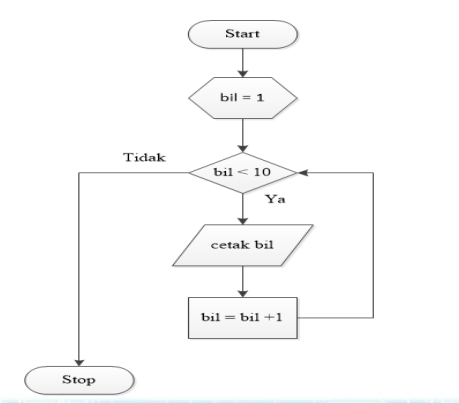


It is a diagram that describes the logical arrangement of a program. The symbols used are as follows:
| Symbol | Symbol Name | Description |
|---|---|---|
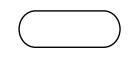 | Terminal | as the beginning (contains ‘Start’) and as the end (contains ‘End’/‘Stop’). |
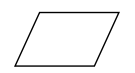 | Input/Output | Reads input or displays output. |
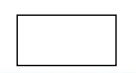 | Process/Processing | Processes data through arithmetic and logical operations. |
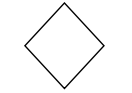 | Decision/(decision box) | Functions to decide the direction/branch taken according to the fulfilled condition, namely True/False. |
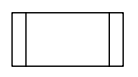 | Subroutine/subprogram | To execute the process of a part (subprogram) or procedure. |
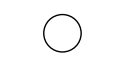 | On page Connector | to connect a disconnected flowchart where the part is still on the same page. |
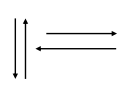 | Flowline/Data flow | The direction part of the executed instruction. |
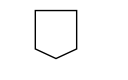 | Off page Connector | Connects a connection from a disconnected flowchart part where the connection is on another page. |
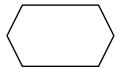 | Preparation | Used for initial value assignment. |
Computer Program Flowchart#
Basically a computer program generally consists of:
- Reading / entering data into the computer
- Performing computation/calculation on the data
- Outputting / printing/ displaying the results.
Flowchart consists of three structures#
- Sequence Structure / Simple Structure Used for programs whose instructions are sequential
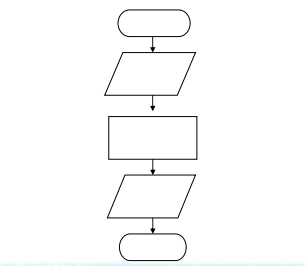
Example of Sequence Structure Flowchart Calculating Triangle Area#
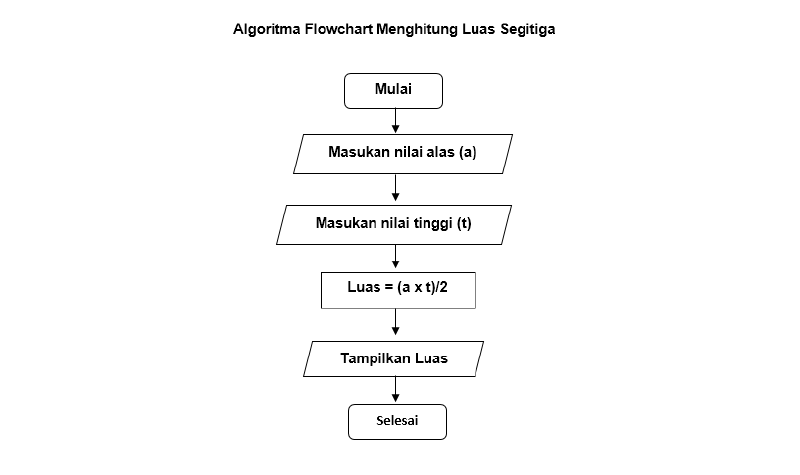
Using Storage Tables#
Table 1. Sequence Storage Media 1
| Command | A | B | Output |
|---|---|---|---|
| A <- 10 | 10 | ||
| A <- 2*A | 20 | ||
| B <- A | 20 | ||
| Write(B) | 20 |
Table 2. Sequence Storage Media 2
| Command | X | Y | Z | Output |
|---|---|---|---|---|
| X <- 100 | 100 | |||
| Y <- X-25 | 75 | |||
| Z <- Y/5 | 15 | |||
| X <- X/(Z+5) | 5 | |||
| Write(X,Y,Z) |
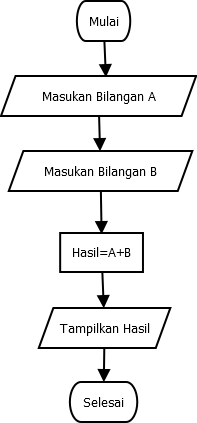
Summing Two Positive Numbers#
Create a flowchart to sum two positive integers and print the result. The algorithm:
- Enter number a
- Enter number b
- Sum numbers a and b
- Print the sum result
Determining Even/Odd Numbers#
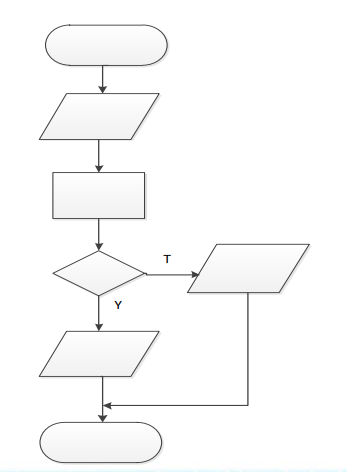
Branching Structure Used for programs that use condition selection. (example determining even/odd numbers)
The algorithm:
- Enter a number
- Divide the number by 2
- If the remainder of the division = 0 then the number is an even number
- If the remainder of the division = 1 then the number is an odd number
Pseudocode:
read number
If number mod 2 = 0 then
“Even Number”
Else
“Odd Number”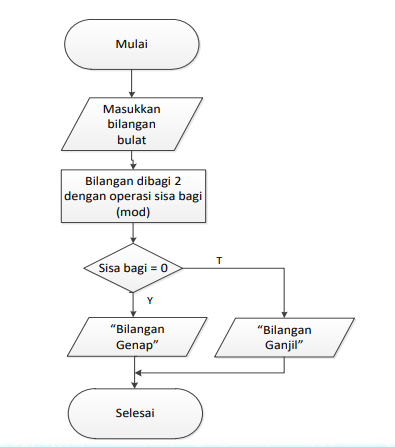
Looping Flowchart#
Looping Structure Used for programs whose instructions will be executed repeatedly.