


Recursion is a process that can call itself.
Example of Recursion Concept
Problem : Slicing bread thinly until it runs out
Algorithm :
- If the bread runs out or the slice is the thinnest possible, the bread slicing is complete.
- If the bread can still be sliced, cut a thin slice from the edge of the bread, then perform procedures 1 and 2 for the remaining part.
Examples of Recursive Functions#
- Power function (Exponentiation)
- Factorial
- Fibonacci
- Tower of Hanoi
Power Function#
Calculating 10 to the power of n using the recursive concept.
In programming notation, it can be written as:
100 = 1 ………………………………………… (1)
10n = 10 * 10n-1 ………………………… (2)
Example:
103 = 10 _ 102
102 = 10 _ 101
101 = 10 * 100
100 = 1
Power Function Program#
# Recursive Power Function
def pangkat(x, y):
    if y == 0:
        return 1
    else:
        return x * pangkat(x, y - 1)

x = int(input("Enter Value X: "))
y = int(input("Enter Value Y: "))
print("%d to the power of %d = %d" % (x, y, pangkat(x, y)))

# Output
Enter Value X: 10
Enter Value Y: 3
10 to the power of 3 = 1000- The power function will call itself; each inputted x and y value will be sent to the
pangkat()function through the parametersxandy. - As long as the value of y is not 0, the
pangkat()function will continue calling itself, and the value of y will always decrease by 1 (y-1) until the condition is met and the repetition stops.
Factorial#
0! = 1
N! = N x (N-1)! For N > 0
In programming notation, it can be written as:
FAKT(0) = 1 ………………………………………. (1)
FAKT(N) = N * FAKT(N-1) ……………………………. (2)
Example:
FAKT(5) = 5 _ FAKT(4)
FAKT(4) = 4 _ FAKT(3)
FAKT(3) = 3 _ FAKT(2)
FAKT(2) = 2 _ FAKT(1)
FAKT(1) = 1 * FAKT(0)
Recursive Factorial Calculation#
Calculate 5!, it can be done recursively as follows: 5! = 5 * 4!
Recursively, the value of 4! can be recalculated as 4 _ 3!, so 5! becomes: 5! = 5 _ 4 * 3!
Recursively, the value of 3! can be recalculated as 3 _ 2!, so 5! becomes: 5! = 5 _ 4 _ 3 _ 2!
Recursively, the value of 2! can be recalculated as 2 _ 1, so 5! becomes: 5! = 5 _ 4 _ 3 _ 2 * 1 = 120.
Factorial Program#
# Recursive Factorial Function
def faktorial(a):
    if a == 1:
        return a
    else:
        return a * faktorial(a - 1)

bil = int(input("Enter a Number: "))
print("%d! = %d" % (bil, faktorial(bil)))

# Output
Enter a Number : 5
5! = 120

Enter a Number : 6
6! = 720
Factorial Function#
- The Factorial function is a recursive function because it calls itself.
- When executed, the program will prompt to “Enter a Number” into the variable
bil, then the number will be sent to thefaktorial()function via parametera. - As long as the value of
ais not 1, the factorial function will continue calling itself. The repetition will stop when the value = 1.
Fibonacci#
Fibonacci Sequence : 0, 1, 1, 2, 3, 5, 8, 13, ………
In programming notation, it can be written as:
Fibo(1) = 0 & Fibo(2) = 1 …………………………………. (1)
Fibo(N) = Fibo(N-1) + Fibo(N-2) …………………………… (2)
Example:
Fibo(5) = Fibo(4) + Fibo(3)
Fibo(4) = Fibo(3) + Fibo(2)
Fibo(3) = Fibo(2) + Fibo(1)
Fibonacci Sequence Program#
def fibonacci(n):
    if n == 0 or n == 1:
        return n
    else:
        return fibonacci(n - 1) + fibonacci(n - 2)

x = int(input("Enter Fibonacci Sequence Limit: "))
print("Fibonacci Sequence:")
for i in range(x):
    print(fibonacci(i), end=' ')

# Output
Enter Fibonacci Sequence Limit: 5
Fibonacci Sequence
0 1 1 2 3

Enter Fibonacci Sequence Limit: 8
Fibonacci Sequence
0 1 1 2 3 5 8 13
Fibonacci Function#
- The Fibonacci function is a recursive function that calls itself.
- Fibonacci numbers are numbers that have initial terms of 0 and 1, and the next term is the sum of the previous two terms.
- The Fibonacci function will keep calling itself when (value
n) is not 0 or 1 by performing an addition process (fibonacci(n-1) + fibonacci(n-2)).
Tower of Hanoi Concept#
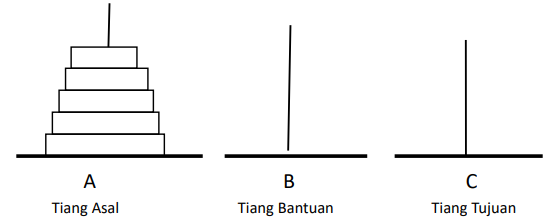
- If n=1, then simply move the disk from peg A to peg C & done.
- Move the top n-1 disks from peg A to peg B.
- Move the nth disk (last disk) from peg A to peg C.
- Move n-1 disks from peg B to peg C.
The moving steps above can be changed into the following notation:
Tower(n, source, auxiliary, destination)
- For a number of disks n > 1, it can be divided into 3 resolution notations:
- Tower(n-1, Source, Destination, Auxiliary);
- Tower(n, Source, Auxiliary, Destination); or Source -> Destination;
- Tower(n-1, Auxiliary, Source, Destination);
Disk Moving Steps#
TOWER(1, A, C, B)
Move disk from peg A to peg B: A → BTOWER(2, A, B, C)
Move two disks from peg A to peg C: A → C
Move one disk from peg A to peg B: A → BTOWER(1, B, A, C)
Move disk from peg B to peg C: B → CTOWER(3, A, C, B)
Move three disks from peg A to peg B: A → B
Move one disk from peg A to peg C: A → C
Move two disks from peg A to peg B: A → BTOWER(1, C, B, A)
Move disk from peg C to peg A: C → ATOWER(2, C, A, B)
Move two disks from peg C to peg B: C → B
Move one disk from peg C to peg A: C → ATOWER(1, A, C, B)
Move disk from peg A to peg B: A → BTOWER(1, A, C, B)
Move one disk from peg A to peg C: A → CTOWER(4, A, B, C)
Move four disks from peg A to peg B: A → B
Move one disk from peg B to peg C: B → C
Move two disks from peg B to peg A: B → A
Move one disk from peg C to peg B: C → B
Move three disks from peg A to peg C: A → C
Move one disk from peg A to peg B: A → B
Move two disks from peg A to peg C: A → C
Move one disk from peg B to peg A: B → A
Move one disk from peg B to peg C: B → C
Move one disk from peg A to peg B: A → B
Move one disk from peg C to peg A: C → ATOWER(1, B, A, C)
Move disk from peg B to peg C: B → C
The illustration above produces 15 completion steps from the Tower of Hanoi concept problem with 4 disks.
For a video of the Tower of Hanoi concept, it can be seen at:
Link
Moving Steps Formula:
2N - 1
N = Number of Disks