
Understanding Operators#
A programming language is also required to be able to process operand values (variables or constants being operated on) using operators, such as adding, dividing, and so on.
An operator is a symbol that functions to perform a specific action / operation on an operand value, which generally produces a new value from the result of the operation. While an operand is a value involved in the operation by the operator.
Types of Operators#
- Arithmetic Operators These operators are used to perform mathematical calculations, as follows:
| Operator | Name | Example | Result |
|---|---|---|---|
| + | Addition | 1+4 | 5 |
| - | Subtraction | 1-4 | -3 |
| / | Division | 1/4 | 0.25 |
| * | Multiplication | 1*4 | 4 |
| % | Modulus | 5%2 | 1 |
| ++ | Increment | X=5; X++ | X=6 |
| - | Decrement | X=5; X- | X=4 |
Script example:
Operatoraritmatika.php
<?php
$bil1=200;
$bil2=40;
$hasil = $bil1+$bil2;
echo "$bil1 + $bil2 = $hasil<br>";
$hasil = $bil1-$bil2;
echo "$bil1 - $bil2 = $hasil<br>";
$hasil = $bil1*$bil2;
echo "$bil1 * $bil2 = $hasil<br>";
$hasil = $bil1/$bil2;
echo "$bil1 / $bil2 = $hasil<br>";
?>
Result:
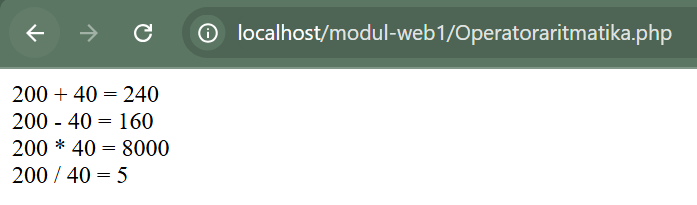
- Comparison Operators Comparison operators are used to produce 2 values whose final result is a Boolean value of true and false. These operators are very useful in programming because they can determine the direction of programming. Comparison operators in PHP are:
| Operator | Name | Example | Result |
|---|---|---|---|
| == | Equal to | 6 == 6 | False |
| != | Not equal to | 3!=3 | False |
| > | Greater than | 1>5 | False |
| >= | Greater than or equal to | 3>=4 | False |
| < | Less than | 2<4 | True |
| <= | Less than or equal to | 5<=4 | False |
Opertorperbandingan.php
<?php
$bil1 = 200;
$bil2 = 40;
$teks1 = "PHP";
$teks2 = "php";

$hasil = $bil1 == $bil2;
echo "$bil1 == $bil2 = $hasil<br>";

$hasil = $bil1 != $bil2;
echo "$bil1 != $bil2 = $hasil<br>";

$hasil = $bil1 >= $bil2;
echo "$bil1 >= $bil2 = $hasil<br>";

$hasil = $teks1 == $teks2;
echo "$teks1 == $teks2 = $hasil<br>";

$hasil = $teks1 != $teks2;
echo "$teks1 != $teks2 = $hasil<br>";
?>
Result: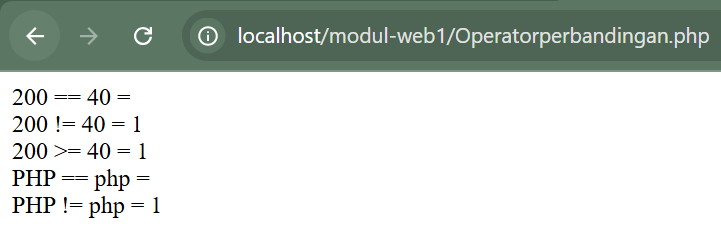
- Logical Operators Operators for composing logical expression statements. The result of this operation will get a value of one if true and zero if false.
| Operator | Function |
|---|---|
| AND or && | AND logical operation |
| OR or || | OR logical operation |
| XOR | Exclusive OR logical operation |
| ! | Negation/NOT |
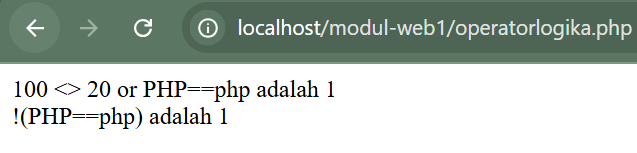
Operatorlogika.php
<?php
$bil1 = 100;
$bil2 = 20;
$teks1 = "PHP";
$teks2 = "php";

$hasil = ($bil1 <> $bil2) or ($teks1 == $teks2);
echo "$bil1 <> $bil2 or $teks1==$teks2 adalah $hasil<br>";

$hasil = !($teks1 == $teks2);
echo "!($teks1==$teks2) adalah $hasil";
?>
Result:
- String Operators In PHP there are also string operators, which are used for text concatenation operations. The symbol used is a dot (.) character.
Operatorstring.php
<?php

$teks1 = "Aku Sedang belajar";
$teks2 = "Pemrograman Web";
$teks3 = "Menggunakan bahasa script PHP";
$hasil = $teks1 . $teks2 . $teks3;

echo "$hasil ";
?>
Result: